
The Best HTML-To-Image APIs In 2026: An Honest Comparison
You want to turn HTML and data into a PNG over an API. Five tools claim to do it. They don't cost the same, and they don't do the same job.
The best HTML-to-image API depends on what you're rendering. For pay-as-you-go image rendering from your own HTML, htmlcsstoimage and propzapi are the cheapest on-ramps. For a no-code visual editor and video, Bannerbear or Placid. For screenshotting live URLs at scale, ScreenshotOne. I build propzapi, so I have a side. But the pricing below is sourced from each vendor's own page, and I'll tell you plainly where propzapi loses.
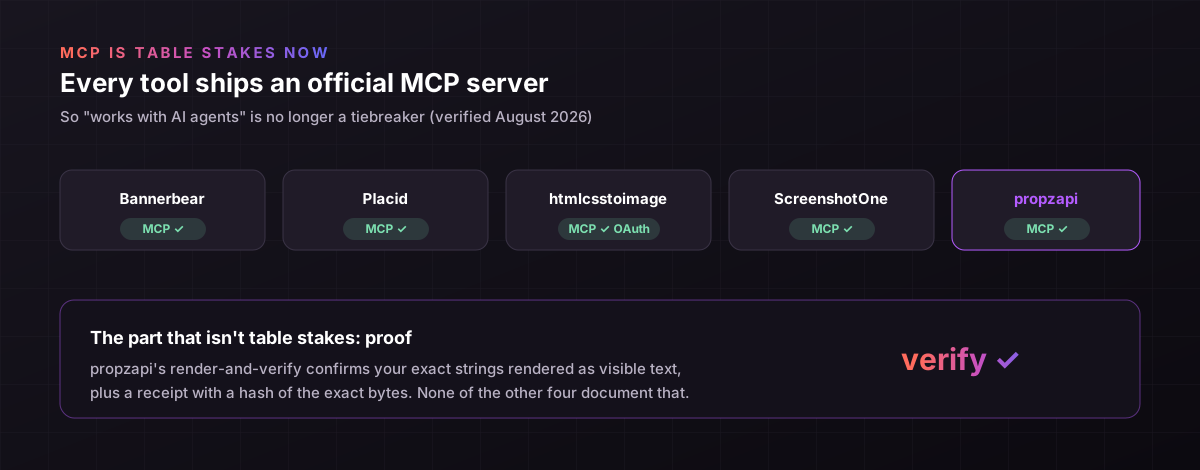
Here's the part most comparison posts get wrong in 2026, so I'll lead with it. All five of these tools now ship an MCP server, so "works with AI agents" is no longer a tiebreaker. The real differences are price model, whether you draw templates or write them, and whether the tool can prove what it rendered.
Which HTML-to-image API is best for developers?
For developers rendering images from data, the answer is really two tools: htmlcsstoimage if you want the lowest per-image price on a subscription, or propzapi if you want to pay per image with no monthly floor. Both take your own HTML/CSS instead of a visual editor. Bannerbear and Placid are better when a non-developer owns the template or you need video. ScreenshotOne wins when the job is screenshotting live URLs, not rendering your own markup.
That's the whole article in a paragraph. The rest is why.
Every tool here does the same core trick: it runs your content through a real browser engine and hands back an image. The differences are in the wrapper. Some give you a drag-and-drop canvas. Some take raw HTML. Some are built to screenshot a URL you don't control. And the billing splits into two camps that matter more than any feature.
The two kinds of image API you're choosing between
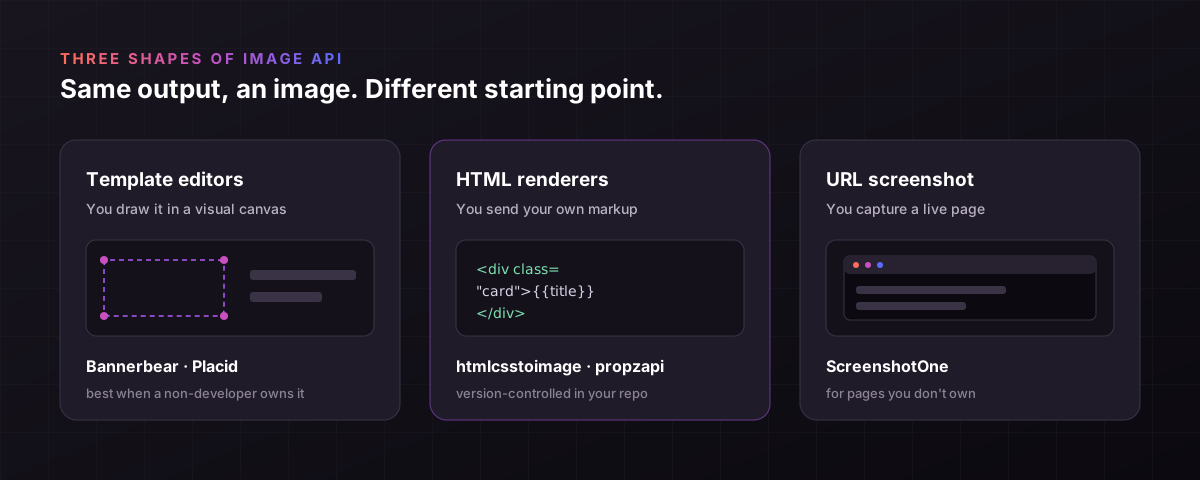
There are two shapes of image API, and picking the wrong shape is the mistake I see most. Template-editor APIs (Bannerbear, Placid) give you a visual canvas: you draw the layout, bind fields, then fill those fields over the API. HTML-rendering APIs (htmlcsstoimage, propzapi) take your markup directly and rasterise it. ScreenshotOne is a third shape: it captures a live URL. Same output, an image, but a different starting point and a different kind of team reaching for each.
The split decides who on your team owns the template.
If a marketer needs to tweak a promo card without a deploy, a visual editor is the point. That's Bannerbear and Placid, and it's a real strength, not a weakness. Third-party roundups of the space draw the same line, splitting image-generation APIs into visual-editor tools and code-first renderers.
If a developer owns the template and wants it version-controlled next to the code, writing HTML beats clicking a canvas. That's htmlcsstoimage and propzapi. Your template is a file in a pull request, diffable and reviewable, not a state in someone's editor.
And if you don't own the page at all, if you just want a shot of a live site, you're in screenshot territory. That's where ScreenshotOne lives.
The best HTML-to-image APIs at a glance
Here's every tool with its entry price, free tier, billing model, and what it actually renders, verified from each vendor's pricing and docs pages in August 2026. One credit is one image unless noted. Read the price against the model: a low monthly rate with a high floor is not cheap if your volume is spiky.
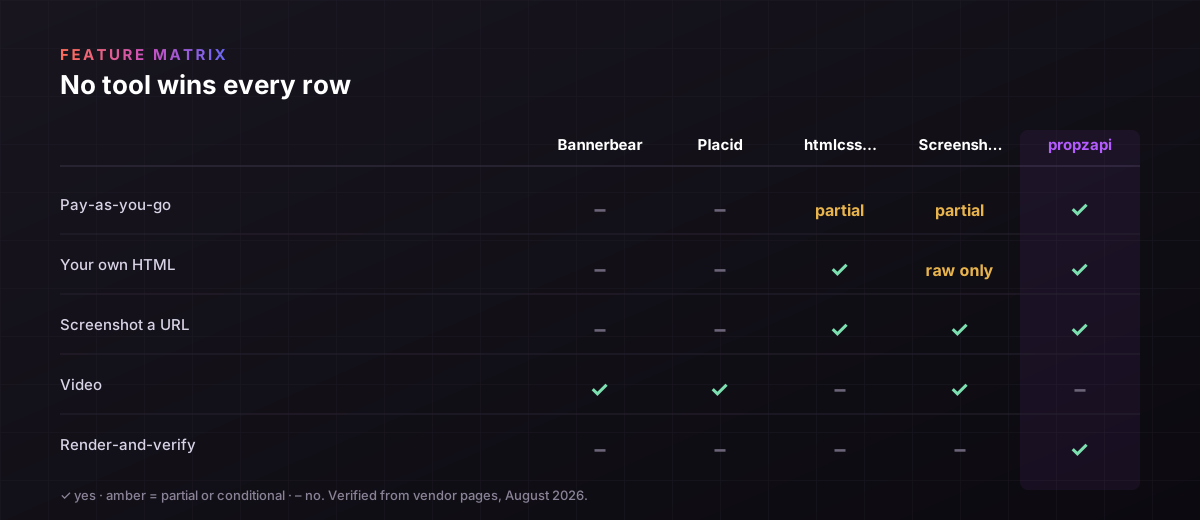
| Bannerbear | Placid | htmlcsstoimage | ScreenshotOne | propzapi | |
|---|---|---|---|---|---|
| Entry price | $49/mo · 1,000 | ~$19/mo · 500* | $14/mo · 1,000 | $17/mo · 2,000 | $5 pack · 150 |
| Free tier | 30-credit trial | Trial credits | 50/mo, ongoing | 100 free | 50, one-time |
| Model | Subscription | Subscription | Sub + overage | Sub + per-shot | Pay-as-you-go |
| You supply | Visual editor | Visual editor | Your HTML/CSS | A live URL | Your HTML/CSS |
| Screenshot a URL | No | No | Yes | Yes | Yes |
| Yes | Yes | Yes | Yes | Yes | |
| Video | Yes | Yes | No | Yes | No |
| MCP server | Official | Official | Official | Official | Official |
Sources: Bannerbear, Placid, htmlcsstoimage, ScreenshotOne. *Placid's pricing page renders dollar figures in JavaScript; the $19 Basic figure is from third-party trackers and Placid's own confirmed 500-credit entry tier. Verify the current number on their page before you commit.
Two things jump out of that table. Every tool has an official MCP server now. And propzapi is the only one whose paid credits don't sit behind a monthly subscription.
What's the cheapest HTML-to-image API?
On steady monthly volume, htmlcsstoimage is the cheapest at $14 for 1,000 images, which works out to about $0.014 an image, cheaper than propzapi's $0.029 on the equivalent plan. But "cheapest per image" and "cheapest for you" aren't the same number. If your usage is low or spiky, the subscription floor decides the bill, and that's where a pay-as-you-go pack wins. Do the math on your real volume, not the sticker rate.
Watch the floor, not the rate.
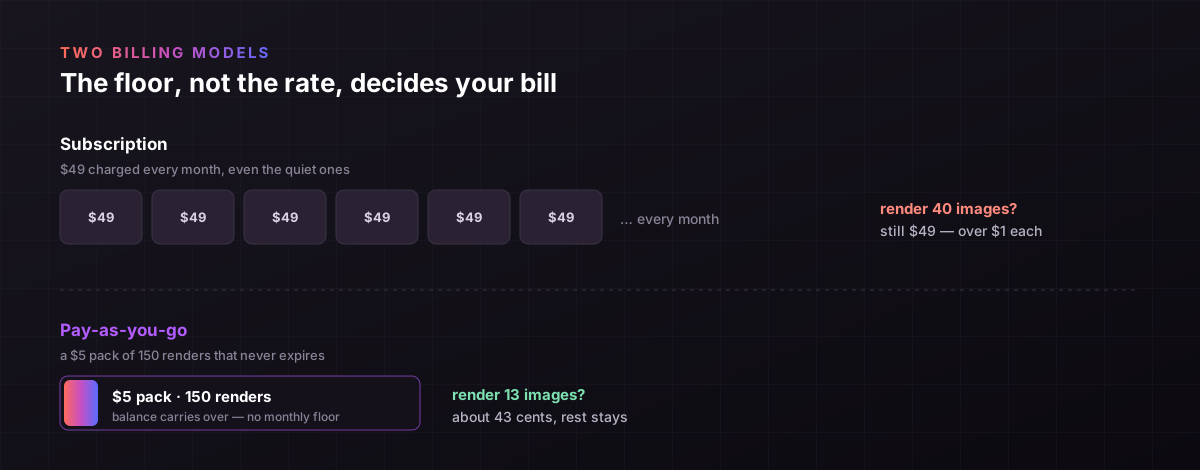
Bannerbear's cheapest plan is $49 a month for 1,000 images, per its pricing page (verified August 2026). Render 40 images that month and each one cost you more than a dollar. The $49 is a floor you pay whether you use it or not.
htmlcsstoimage starts at $14 for 1,000 images and, usefully, keeps a free tier of 50 images a month that doesn't expire after a trial. Its docs also list metered overage at $10 per 1,000 beyond your plan, which is the most pay-as-you-go-flavoured billing of the four subscription tools.
propzapi takes the other road entirely. A $5 pack covers 150 renders and never expires, with no monthly subscription at all. At roughly $0.033 an image that's pricier per unit than htmlcsstoimage's plan rate, but there's no floor: render 13 images this month and you've spent about 43 cents of a pack that keeps its balance. For a side project or spiky workload, no floor beats a low rate.
So the real answer splits in two. Predictable volume above a few hundred a month, htmlcsstoimage. Low or unpredictable volume, propzapi's never-expiring pack.
Do these image APIs work with AI agents and MCP?
Yes, and this is the finding that dates every older comparison. As of August 2026, all five tools ship an official MCP server, so any of them plugs into Claude, Cursor or ChatGPT as a native tool. Bannerbear, Placid, htmlcsstoimage and ScreenshotOne each shipped one, and propzapi is an MCP server itself. MCP support used to be a differentiator. Now it's table stakes, and anyone still selling it as a unique edge is working from a stale map.
I'm saying this against my own interest, because propzapi's marketing used to lean on it.
The receipts, briefly. Bannerbear hosts one at mcp.bannerbear.com. Placid ships a native MCP server you toggle on in-app. htmlcsstoimage's MCP integration even does OAuth, so there's no API key to paste. ScreenshotOne shipped theirs too.
So if an agent needs to make an image, they all qualify. Pick on something else.
The thing that still differs for agents is proof. An agent that renders a receipt or a certificate needs to know the price and the name actually landed as visible text, not that a render came back. propzapi answers that with render-and-verify: pass the strings you expect and the response confirms each one rendered as visible text, plus an optional receipt with a hash of the exact bytes. None of the other four document that. It's the one agent-facing feature that isn't table stakes yet.
The five HTML-to-image APIs, reviewed
Each tool below is the right answer for someone, so here's who should pick each one, with the honest catch attached. Bannerbear and Placid suit non-developers and anyone who needs video. htmlcsstoimage is the value pick for rendering your own HTML at volume. ScreenshotOne is the specialist for capturing live URLs you don't own. propzapi is the pay-as-you-go, code-first option that can prove what it rendered.
Bannerbear: the mature no-code platform
Bannerbear is the broadest tool here and the safest pick for a non-developer. You design in a polished visual editor, then generate images, PDFs or video over a REST API or through Zapier, Make and Airtable. Its plans start at $49 a month for 1,000 credits. The catch is that same $49 floor: it's a lot to pay for a low-volume or code-first workflow, and the templates live in an editor rather than your repo. If a marketer owns the creative and you want video, it's hard to beat.
Placid: creative automation with video
Placid plays the same game as Bannerbear, a visual editor pitched at teams automating on-brand images, PDFs and video. Its entry tier is 500 credits a month (around $19; see the table note), and its credit model is clean: one image is one credit, a PDF page is two, ten seconds of video is ten. Unlimited watermarked previews are free, which is a genuinely nice way to build before you pay. If you want a design canvas plus video and don't mind a subscription, Placid competes directly with Bannerbear.
htmlcsstoimage: the developer's HTML renderer
htmlcsstoimage does exactly what its name says, and it's the value pick for code-first teams. You POST HTML and CSS, or a URL, and get an image or PDF back. It's the cheapest per image on a plan at $14 for 1,000, keeps an ongoing free tier of 50 images a month, and bills overage at $10 per 1,000. It has no video and no visual editor, on purpose. If you render your own markup at predictable volume, this is the one to beat on price.
ScreenshotOne: built for capturing live URLs
This one narrows the job to a single thing and does it well: screenshotting pages you don't own. It captures a live URL to PNG, WebP or JPEG, does full-page and PDF, and adds video on higher tiers. Pricing starts at $17 a month for 2,000 screenshots with extra shots around $0.009 each, and it only charges for successful requests. It's not a template designer and not aimed at rendering your own layouts. For a monitoring tool, a link previewer or a "shot of any site" feature, it's purpose-built.
propzapi: pay-as-you-go, code-first, with proof
propzapi is the one I build, so weigh this accordingly. It renders your own HTML/CSS templates to PNG, JPEG, WebP or a one-page PDF in headless Chromium, screenshots live URLs, and signs og:image embed URLs that render once then cache. Its edge is the billing and the proof: a $5 pack of 150 renders that never expires with no subscription, a 50-image free trial with no card, and render-and-verify plus receipts that confirm your exact text rendered. Its honest gaps: no video, no visual editor, it's the newest tool here, and htmlcsstoimage undercuts it per image at steady volume.
Because the template is just HTML with variables, the render is one call:
# propzapi is code-first: POST a template id + your data, get a URL back
curl https://api.propzapi.com/v1/images \
  -H "X-API-Key: YOUR_API_KEY" -H "Content-Type: application/json" \
  -d '{"template":"og-article","modifications":{"title":"Ship faster"}}'
# → { "url": "https://images.propzapi.com/img_0014….png",
#     "width": 1200, "height": 630, "format": "png" }
# X-Credits-Cost: 1   X-Credits-Remaining: 49
Should you self-host Puppeteer instead of paying for an API?
Self-host when rendering is your core product and you have the ops budget. Use an API when it's a feature, not the business. Running Puppeteer yourself is free in license terms but real in maintenance: headless Chromium is memory-hungry, breaks on font and emoji edge cases, and the AWS Lambda size limits push teams to heavier infra than they planned. For most teams, a few dollars of API calls beats the server plus the on-call.
The build-versus-buy line is pretty specific.
If you render millions of images and a fraction of a cent each matters more than engineering time, self-host. You'll own the browser pool, the font stack, and the 3am restarts, and at that scale it pays off.
If you render thousands, not millions, the API wins on total cost. A crashed render on a hosted API charges nothing and pages nobody. A crashed Chromium on your box at 3am pages you. That trade is the whole reason these five companies exist.
There's a middle path worth naming: build-time generation with a library like Satori or @vercel/og for static OG images, and an API for anything dynamic or on-demand. Plenty of teams run both.
Which HTML-to-image API should you choose?
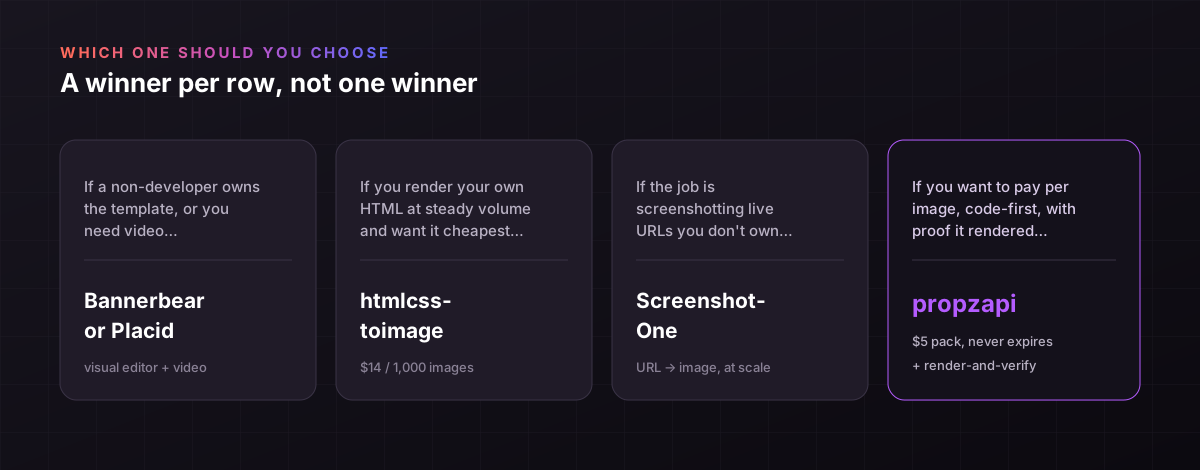
Match the tool to the job and the team. Choose Bannerbear or Placid if a non-developer owns the template or you need video. Choose htmlcsstoimage for the cheapest per-image rendering of your own HTML at volume. Choose ScreenshotOne to screenshot live URLs. Choose propzapi to pay per image with no monthly floor, render from code, or prove your exact text landed. No single winner here, just a winner per row.
I won't pretend the tool I build wins every case.
If you need video, propzapi doesn't do it and three of the others do. If you want the lowest per-image price at volume, htmlcsstoimage beats it. If a designer needs to own templates in a canvas, a code-first API is the wrong shape.
But if you're a developer rendering cards, invoices, certificates or OG images from data, want to pay for what you use, and would rather write HTML than click a canvas, the pay-as-you-go price and the render-and-verify proof land where a platform subscription doesn't. Start with the free tier of whichever row is yours.
Frequently asked questions
- Is there a free HTML-to-image or screenshot API?
- Yes, several. htmlcsstoimage keeps an ongoing free tier of 50 images a month, ScreenshotOne gives 100 free screenshots with no card, and propzapi offers a one-time 50-image trial with no card. Bannerbear and Placid run trial credits rather than a standing free plan. For a genuinely free ongoing allowance, htmlcsstoimage and ScreenshotOne have the most generous standing tiers as of August 2026.
- What's the cheapest Bannerbear alternative?
- For rendering your own HTML, htmlcsstoimage at $14 a month for 1,000 images is the cheapest per-image alternative, and propzapi is the cheapest to start because a $5 pack has no subscription floor and never expires. Bannerbear's entry plan is $49 a month, so both undercut it heavily on price. The trade-off is fair: Bannerbear's price also buys a visual editor and video, which neither cheaper tool has.
- HTML-to-image or screenshot a URL: which approach should I use?
- Use HTML-to-image when you control the content and want a precise, designed output like a card or certificate. Use a URL screenshot when you don't own the page or want it exactly as a browser shows it. htmlcsstoimage and propzapi do both; ScreenshotOne specialises in the URL case; Bannerbear and Placid are template-first and don't screenshot arbitrary URLs. Pick by whether you're rendering your own markup or capturing someone else's page.
- Which image generation API has an MCP server for AI agents?
- All five in this comparison do, as of August 2026. Bannerbear, Placid, htmlcsstoimage and ScreenshotOne each ship an official MCP server, and propzapi is an MCP server itself. So MCP support is no longer a reason to pick one over another. If your agent needs to prove the text rendered correctly, propzapi's render-and-verify is the feature that still differs.
- Should I self-host Puppeteer or pay for an API?
- Self-host if image rendering is your core product and you can staff the browser pool, font stack and restarts; pay for an API if rendering is a feature. At thousands of images a month, an API is almost always cheaper once you count engineering time and on-call. At millions, self-hosting's per-image cost can win. Many teams split it: a build-time library for static images, an API for dynamic ones.
- How do I generate dynamic OG images with an API?
- Store one 1200x630 template, then render it per page with that page's title and data, and drop the resulting URL into your og:image meta tag. With an HTML-rendering API you write the template as HTML/CSS; with a template-editor API you draw it once. propzapi signs an embed URL that renders on first crawl and caches after, so a shared post costs one render no matter how many crawlers hit it. Any of the five tools can produce the image; the difference is whether you author the template in code or a canvas.
Start with the row that's yours
Don't pick on a feature list. Pick on who owns the template, whether you need video, and how spiky your volume is. If that points at a code-first, pay-as-you-go renderer with proof your text landed, grab a free propzapi key, POST your HTML, and render it. Fifty images, no card. If it points at a visual editor or video, use Bannerbear or Placid instead, no hard feelings.