
htmlcsstoimage Alternative: When It's Worth Switching
Most "htmlcsstoimage alternative" pages have one move: they're cheaper. I'm not going to do that, because on price I'd lose.
htmlcsstoimage is a mature, cheap HTML-to-image API, and it already does formats, PDF, screenshots, templates, and MCP. Most alternatives just undercut it on price, and propzapi is not one of them: it costs more per image. propzapi has exactly one thing htmlcsstoimage and the rest of the field don't, which is render-and-verify. This is an honest comparison of when that one thing is worth switching for, and when it isn't.
I build propzapi, and I'll tell you plainly where htmlcsstoimage wins, because most of the time it does. There's a narrow case where propzapi is the right call, and I'd rather define it honestly than oversell it.
Should you switch from htmlcsstoimage at all?
Usually not. htmlcsstoimage has run since 2018, renders exactly like Chrome, costs $14 per 1,000 images with a free tier, and is used by Dev.to and Product Hunt. It's a mature incumbent with wrappers in most languages and years of Stack Overflow answers. Switching makes sense only for a specific capability it lacks, not as a default, so start by naming the thing you actually need that it doesn't do.
Be honest about why you're looking.
If htmlcsstoimage renders your images correctly at a price you're fine with, there's no reason to move, and any "alternative" article telling you otherwise is selling something. The only good reasons to switch are concrete: you want it cheaper, you want a visual editor, or you need a capability it doesn't have. Each of those points at a different tool.
What htmlcsstoimage already does well
More than people assume. It renders HTML and CSS to PNG, JPEG, and WebP exactly like Chrome, outputs PDF through a .pdf URL, screenshots public pages, and offers a Templates API for reusable designs. It supports emoji, gradients, shadows, and Google Fonts. For a developer who just needs images or PDFs from markup, it covers the job at a low price, which is why it's the one everyone compares against.
This matters because it kills a few lazy pitches.
You'll see alternatives claim htmlcsstoimage "can't do PDF" or "has no templates." Both are false: it renders PDF via the .pdf extension and has a Templates API. Its real limits are narrower, like fonts restricted to Google Fonts and no webhook delivery. Those are worth knowing, but they're not the gap that justifies paying more.
If you're switching to save money, look elsewhere
Then propzapi is the wrong pick, and I'll say so. If lower cost is your only reason to leave htmlcsstoimage, cheaper renderers with the same Chrome output undercut it directly: html2img at about $9 per 1,000 and Rendex near $1.90 per 1,000 with a generous free tier. propzapi costs more per image than htmlcsstoimage, not less, so a price-driven switch shouldn't land here.
I'd rather tell you that than waste your time.
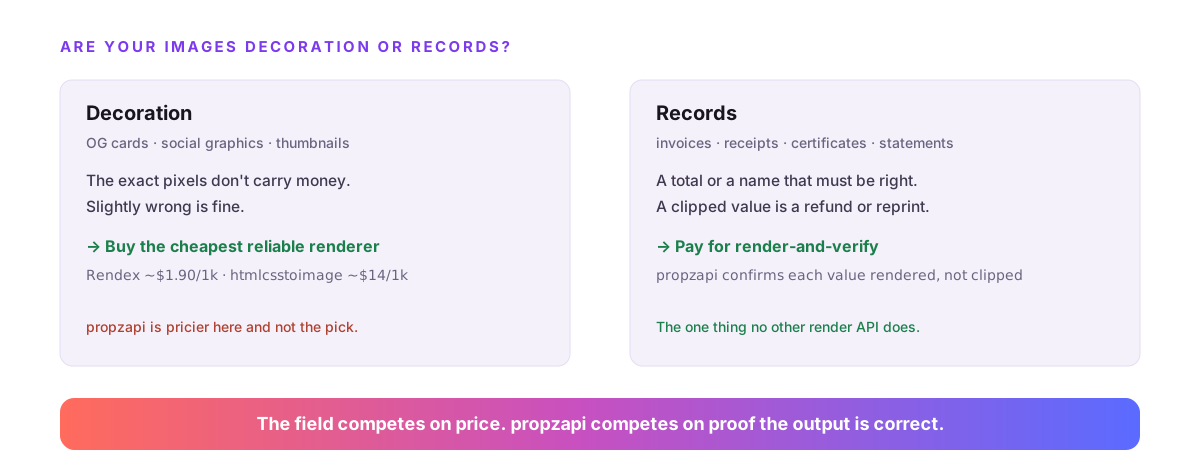
The htmlcsstoimage-alternative market mostly competes on this one axis, and it's a race down. If your images are OG cards or social graphics where the exact pixels don't carry money, the cheapest reliable renderer wins, and propzapi isn't it. Pick on price and move on.
propzapi only makes sense when the axis changes from cost to correctness. That's the next section, and it's the whole reason this article exists.
The one thing none of these do: verify the output
Not htmlcsstoimage, not the cheaper clones, not the editor tools: none confirm the output rendered correctly. With propzapi you pass verify with the exact strings you expect, and the response returns verified plus a check that each rendered as visible pixels, not clipped. It's a DOM check in the same render pass, not OCR. On an image carrying a number or name that must be right, that's the difference.
The rest of the field ships the image and assumes it came out fine.
But a long value overflows its box and clips. A custom font fails to load on the render host and the text falls back or disappears. A missing data field renders blank. With any other API you find out when a customer does, because at volume no one is checking each image by eye.
# The one reason to pick propzapi over htmlcsstoimage: prove the output.
curl https://api.propzapi.com/v1/images \
  -H "X-API-Key: pk_live_…" -H "Content-Type: application/json" \
  -d '{"template":"og-article","format":"png",
       "modifications":{"title":"Q3 revenue: $4,200,000"},
       "verify":["$4,200,000"]}'
# → { "url":"https://images.propzapi.com/img_2ef7….png",
#     "verified": true,
#     "checks": [ {"text":"$4,200,000","found":true,"clipped":false} ] }
That verified: true comes back in the same call that renders the image, and a failed check doesn't change the charge. Wire it into your job and a clipped total becomes a caught error before the image ships. It's the single capability propzapi has that htmlcsstoimage and the rest of the field don't, and everything else here is roughly parity.
propzapi vs htmlcsstoimage, honestly
On features they're close: both render PNG/JPEG/WebP and PDF, both screenshot URLs, both have templates, both ship MCP. htmlcsstoimage wins on price and maturity; propzapi adds two things, render-and-verify and full sandboxed Jinja with loops and conditionals rather than plain variable substitution. So the honest split is cost and community versus proof-of-output and richer templating.
| htmlcsstoimage | propzapi | |
|---|---|---|
| Formats | PNG/JPEG/WebP + PDF | PNG/JPEG/WebP + PDF |
| Screenshot URLs | Yes | Yes |
| Templates | Templates API | HTML + Jinja loops/filters |
| MCP | Yes | Yes |
| Price / 1,000 | ~$14 | ~$30 |
| Maturity | Since 2018, large community | Newer |
| Verify the output | No | Yes |
Read that table honestly and most rows favor htmlcsstoimage or tie. The bottom row is the only one propzapi wins outright, and whether it's worth the price difference depends entirely on what your images carry.
How do you switch from htmlcsstoimage?
The models are close, so migrating is small. htmlcsstoimage renders HTML you send per call or from its Templates API; propzapi stores an HTML template once and you POST the template id plus your data. Move your existing HTML into a propzapi template, point the call at /v1/images, and add verify. Both render with Chromium, so your CSS and fonts carry over unchanged, and the request shape is close to what you already send.
The one real change is that propzapi is template-first.
# Migration step 1: move your htmlcsstoimage HTML into a stored template.
curl https://api.propzapi.com/v1/templates \
  -H "X-API-Key: pk_live_…" -H "Content-Type: application/json" \
  -d '{"name":"og","width":1200,"height":630,
       "html":"<div style=\"padding:80px;font:64px sans-serif\">{{title}}</div>"}'
# → { "template": "tpl_…" }   then POST template id + data to /v1/images, same as before
After that, each render is a POST with the template id and your data, the same shape as htmlcsstoimage's template calls. The one addition in the request is the verify array, and the one addition in the response is the verified flag.
Budget about an hour per template to move the HTML and re-check the output. Because the engine is the same Chromium underneath, the layout usually carries over cleanly, and verify tells you the moment it doesn't.
Where verify earns the higher price
On documents where a wrong value is expensive: invoices, receipts, certificates, statements, dashboards. There the image isn't decoration, it's a record with a total or a name that has to be exactly right, and a clipped or dropped value is a refund, a reprint, or an angry customer. Paying more per image to prove each one rendered correctly is a good trade there, and a bad one for a social card.
So the question isn't propzapi versus htmlcsstoimage in general.
It's whether your images are decoration or records. A blog OG image can be slightly wrong and nobody's hurt, so buy the cheapest renderer. An invoice with a total, or a certificate with a recipient's name, can't be wrong, and finding out after you've emailed a thousand of them is the expensive path.
That's the line. If you're rendering records, the verify check is worth more than the price gap. If you're rendering decoration, it isn't, and htmlcsstoimage is the better buy.
htmlcsstoimage alternative pricing in 2026
On price, propzapi is mid-pack to expensive, and I won't pretend otherwise. Rendex is the cheapest at about $1.90 per 1,000, html2img is $9, htmlcsstoimage is $14, and propzapi is roughly $30 per 1,000 on pay-as-you-go packs that never expire, with 50 free to start. You pay propzapi's premium for verify, not for cheaper rendering.
| Tool | Approx price / 1,000 | Free tier | Verify output? |
|---|---|---|---|
| Rendex | ~$1.90 | 500/mo | No |
| html2img | ~$9 | 50 | No |
| htmlcsstoimage | ~$14 | 50/mo | No |
| propzapi | ~$30 | 50 (one-time) | Yes |
Prices checked August 2026 from each tool's public pricing. propzapi is the priciest render in this list, and per its own capabilities doc it's not the price leader. The only thing you're buying with the difference is proof the output is correct.
Which should you choose?
Stay on htmlcsstoimage if it renders your images correctly and the price is fine. Switch to Rendex or html2img if you want the same output cheaper. Switch to propzapi only if your images carry values that must be right and you want that proven at render time. For most social and OG images, htmlcsstoimage or a cheaper renderer is the honest answer; for records, propzapi's verify is the reason to pay more.
The summary is short because the decision is: are you rendering decoration or records? Decoration goes to the cheapest reliable tool. Records go to the one that proves they're right.
If your images are records, grab a free key and render one with verify on. Fifty renders free, no card, then a $5 pack or a $29 plan.
Frequently asked questions
- Is there a cheaper htmlcsstoimage alternative?
- Yes, and it isn't propzapi. htmlcsstoimage is $14 per 1,000 images; cheaper rivals like html2img at $9 and Rendex around $1.90 per 1,000 undercut it directly on the same Chrome-rendered output. propzapi costs more per image than htmlcsstoimage, so if lower price is your only reason to switch, one of those is the honest answer, not propzapi.
- Does htmlcsstoimage support PDF and templates?
- Yes to both. htmlcsstoimage renders PDF via a .pdf URL, has a Templates API for reusable designs, and can screenshot public URLs, so it does more than single images. It's been running since 2018 with a large community and wrappers in most languages. On raw HTML-to-image, it's a strong, mature incumbent, which is why switching needs a specific reason.
- What can propzapi do that htmlcsstoimage can't?
- Two things. It verifies the output: pass the exact strings you expect and the response confirms each rendered as visible pixels, not clipped. And it runs full sandboxed Jinja, so templates can loop over arrays and branch on conditionals, rather than only substituting variables. Everything else, formats, PDF, screenshots, MCP, is roughly parity, and htmlcsstoimage is cheaper.
- Is propzapi cheaper than htmlcsstoimage?
- No. htmlcsstoimage is about $14 per 1,000 images; propzapi is roughly $30 per 1,000 on its pay-as-you-go packs. propzapi is not the price leader and doesn't claim to be. The trade is a higher per-image cost for render-and-verify, which is worth it only when a wrong or clipped value in the image is expensive, like an invoice total or a certificate name.
- How do I confirm the image rendered correctly?
- With propzapi you pass verify with the exact strings you expect back, and the response returns verified plus a per-string check that each one rendered as visible pixels and wasn't clipped. It's a DOM check in the same render pass, not OCR. No other HTML-to-image API, htmlcsstoimage included, offers proof-the-text-rendered, which is the one capability propzapi has that the field doesn't.
- When should I switch from htmlcsstoimage?
- Switch for a specific missing capability, not out of habit. Move to a cheaper renderer if price is the issue, to a tool with a visual editor if a non-developer owns the design, or to propzapi if your images carry values that have to be correct and you want that proven at render time. If htmlcsstoimage already does what you need at $14 per 1,000, there's no reason to move.